Subscribe to our blog for deeper insights and more
A Comparison of GPT 4, Llama, Claude, AI Studio & Perplexity
Posted On September 5, 2024
Written by Emma JosephTransforming the Future with White Label Blockchain and AI
Share Article:
White Label Blockchain & AI Expert with 7+ years of experience helping agencies deliver secure blockchain, AI, and Web3 solutions under their own brand. I support partners in scaling faster and expanding their service offerings.
This blog post compares five powerful AI models—GPT 4, Llama, Claude, AI Studio, and Perplexity. It provides insights into their strengths and uses cases to help businesses choose the right AI solution for their needs. Here are the key takeaways:
GPT 4 excels in language generation with versatile applications
Llama is ideal for lightweight, open-source projects
Claude focuses on ethical AI use with an emphasis on transparency
AI Studio offers user-friendly AI development for diverse industries
Perplexity stands out for real-time interaction and data accuracy
Feeling overwhelmed by the number of AI language models available?
Selecting the best model for your needs can be difficult, especially with many options that promise exceptional performance.
That’s why we have created this comprehensive guide for you!
In this blog, we will explore the capabilities and features of five popular AI language models: GPT 4, Llama, Claude, AI Studio, and Perplexity. We’ll assist you in identifying their features and differences so you can make the best decision for your AI applications.
Table of Contents
Overview of Each AI Model
Let’s begin by understanding about these AI language models:
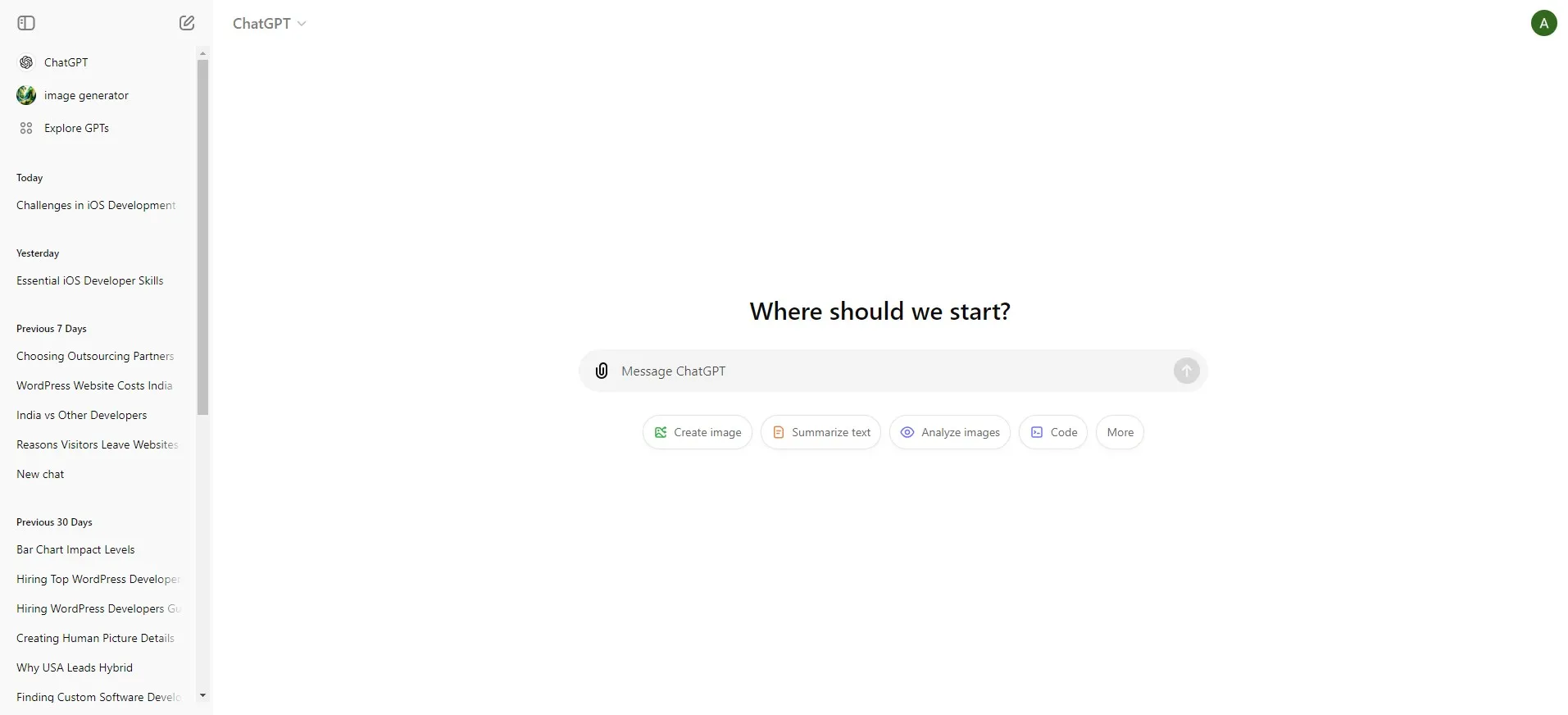
1. GPT 4
GPT 4, developed by OpenAI, represents the most recent development of artificial intelligence and language processing. GPT 4 is built to understand and generate human-like content with remarkably accurate and coherent writing. It provides superior context understanding by utilizing a much larger dataset and more sophisticated algorithms, making it a priceless tool for various applications, from customer service to content development.
Features
Enhanced Text Generation
Nuanced Langauge Understanding
Complex Query Handling
Multi-turn Conversations
Sentiment Analysis
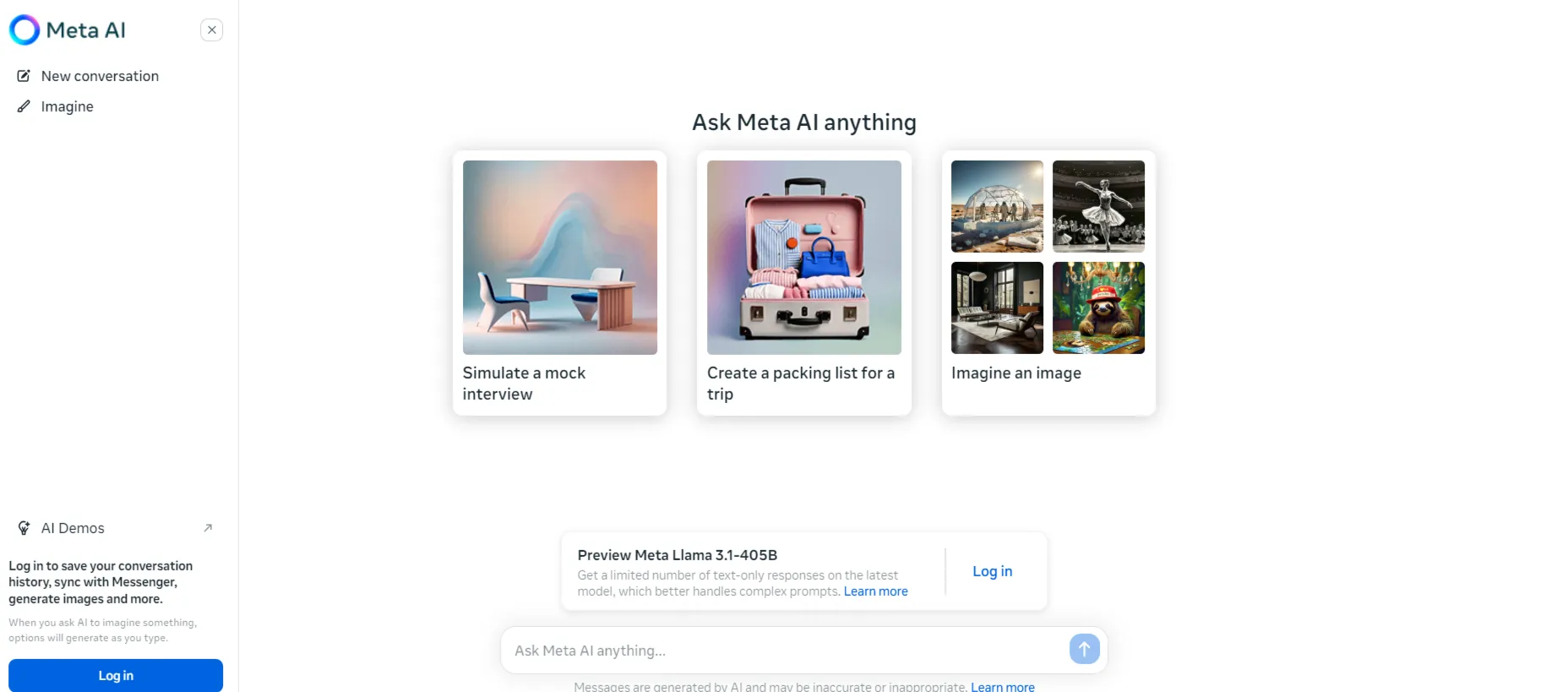
2. Llama
Llama (Large Language Model Assistance) is a complex artificial intelligence model created to assist with various natural language processing activities. It was developed using modern technology and it excels at comprehending and producing human-like text.
It is a priceless tool for various applications, including chatbots development, virtual assistants, content production, and language translation. Llama is designed to fulfill the demands of companies and developers looking for advanced language model capabilities, emphasizing performance and flexibility.
Features
High Accuracy
Multilingual Support
Robust Security
Real-time Processing
Customization
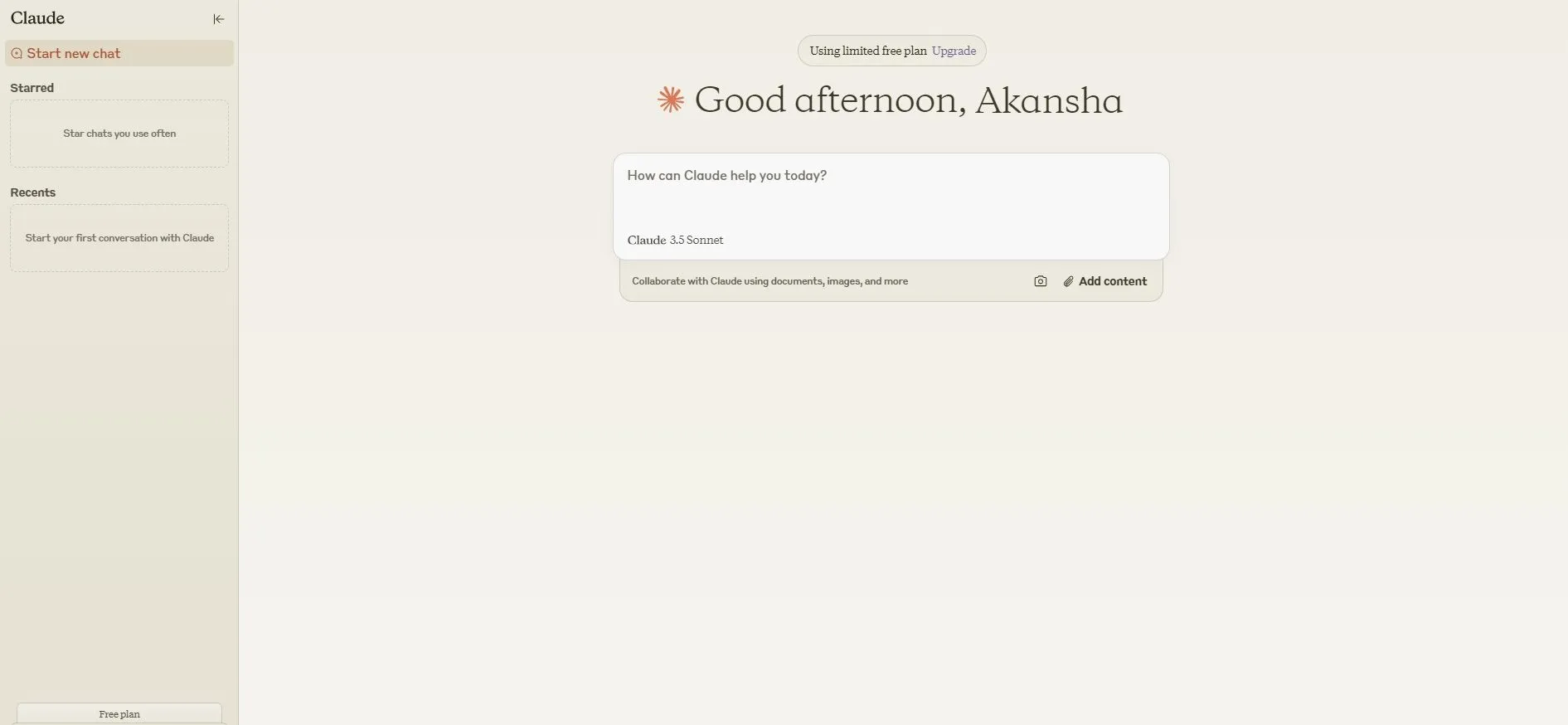
3. Claude
Claude is one of the top AI tools developed by Anthropic that is designed to provide human-like responses in natural language. Named after Claud Shannon, the information theory pioneer, it emphasizes safety and interpretability to minimize harmful outputs while optimizing utility. It is known for its ability to understand context and nuance, making it suitable for various applications, such as chatbots, content creation, and customer service.
Features
Contextual Understanding
Customization Options
Multi-Tasking Capability
Interactive Conversations
User-Friendly Interface
Need Advanced AI Solutions?
Contact us for personalized AI strategies that align with your business goals.
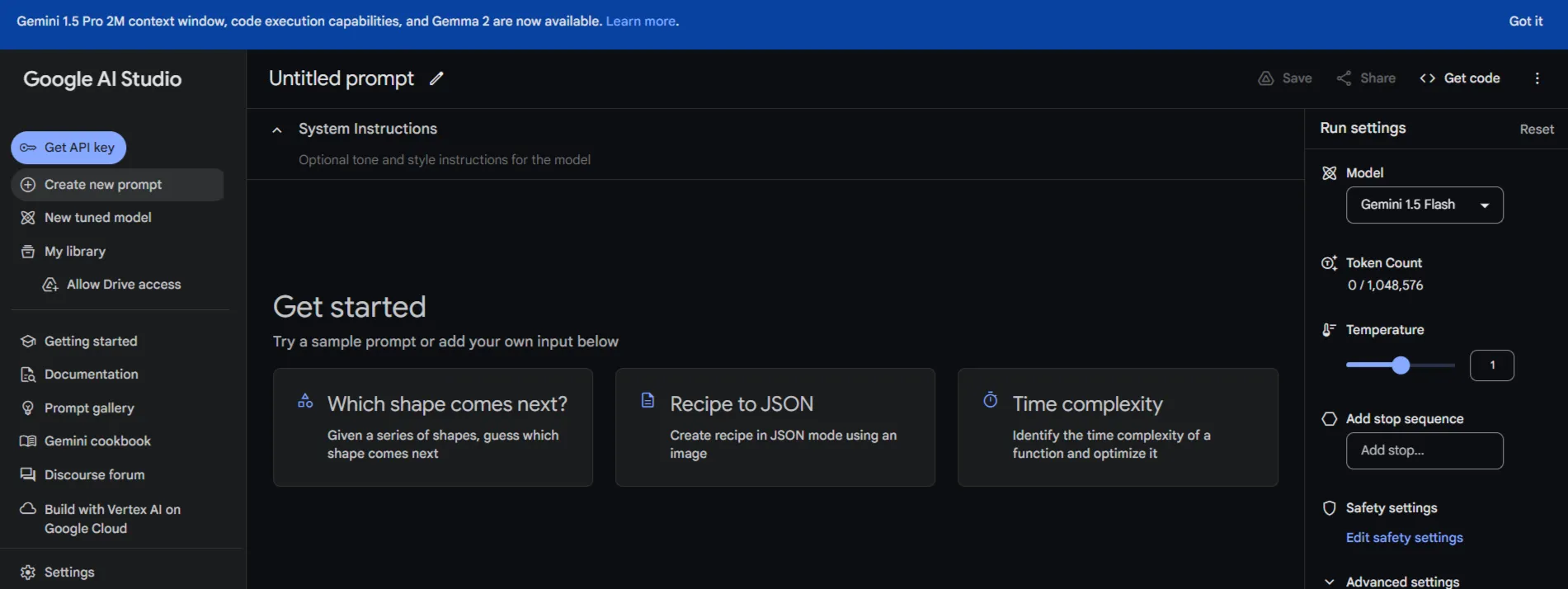
AI Studio is an effective platform designed to develop and implement artificial intelligence applications more easily. With its intuitive interface, developers, data scientists and companies can construct, train and oversee AI models without knowing much about programming.
The platform strongly emphasizes teamwork, allowing groups to share resources and collaborate effectively on AI projects. With its extensive toolkit, AI Studio is a flexible option for businesses leveraging artificial intelligence. It supports various applications such as computer vision, natural language processing and predictive analytics.
Features
No-Code Interface
Collaboration Tools
Pre-built Algorithms
Integration Capabilities
Deployment Options
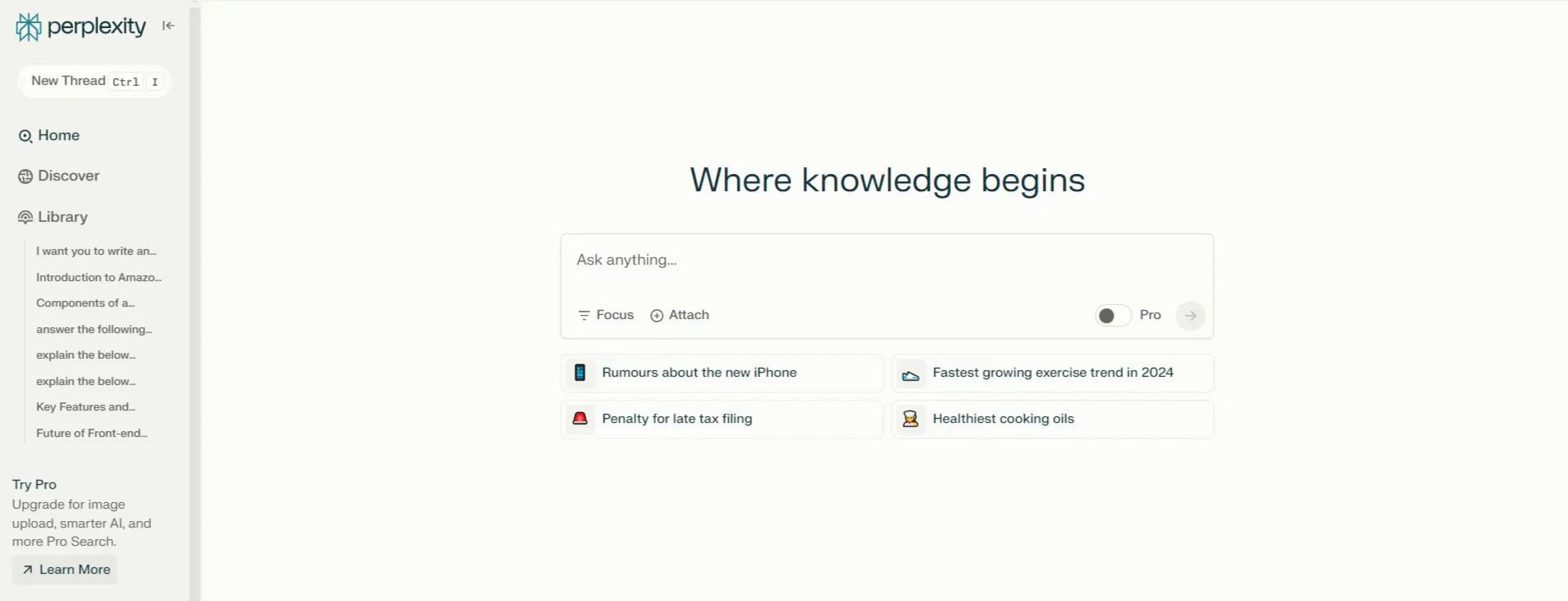
5. Perplexity
Perplexity is an AI language model that improves experience through conversational and information retrieval functions. It has advanced natural language processing to provide precise and context-aware responses, making it valuable for search engines, chatbots, and virtual assistants. Perplexity is excellent at deciphering user inquiries and producing relevant data, which enhances the quality of interactions and insights.
Features
Contextual Understanding
Multi-turn Conversations
Customizable Output
Integration Capabilities
User-Friendly Interface
Transform Your AI Deployment
Get in touch for the successful integration of an AI model that suits your requirements.
Comparison Between GPT 4, Llama, Claude, AI Studio & Perplexity
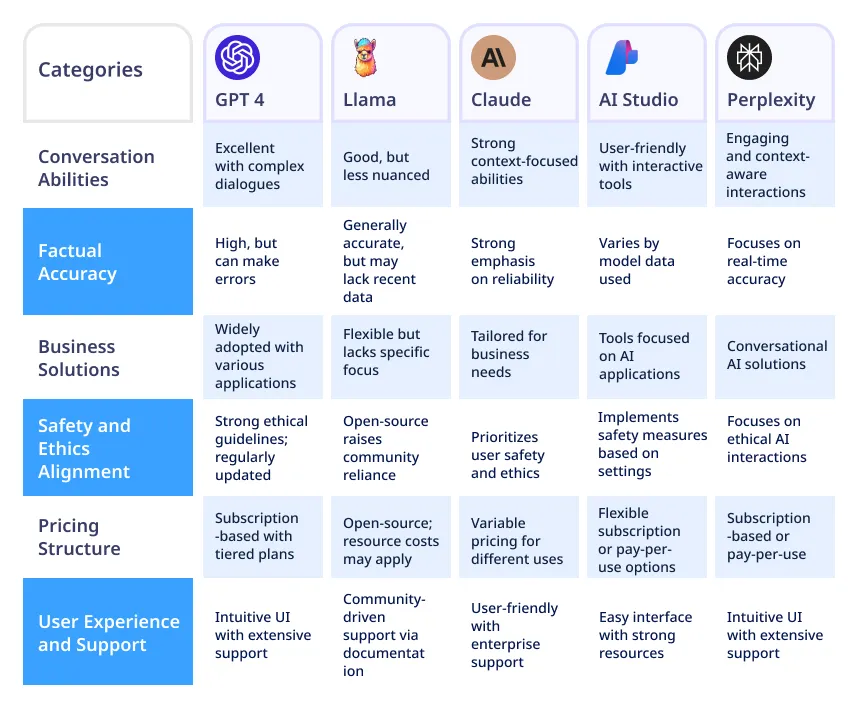
When evaluating the AI language model, it’s critical to comprehend its distinct advantages and characteristics. Here is a brief comparison of GPT-4, Llama, Claude, AI Studio, and Perplexity to assist you in making an informed choice:
1. Conversation Abilities
GPT 4: Known for its sophisticated conversational abilities, GPT 4 converses naturally and comprehends context and subtleties to provide human-like responses. It can be used for informal and formal conversations as it adapts to many tones and styles.
Llama: Llama prioritizes lightweight and effective interactions. It is not as complicated as GPT 4 as it excels in short, direct discussions, which makes it perfect for applications that need quick responses.
Claude: Claude manages multi-turn interactions well by emphasizing context maintenance. It improves user experience and is a good option for continuing conversations as it can recall past conversations.
AI Studio: AI Studio is designed to create and manage conversational AI applications with strong conversational features. It provides a framework on which developers can create customized experiences, enabling extremely specialized bots.
Perplexity: Perplexity is excellent at gathering data and giving responses that consider context. It has informative dialogues that help users look for specific answers even though it is less flexible than GPT 4.
2. Factual Accuracy
GPT 4: Despite its stellar conversational abilities, GPT-4’s factual accuracy varies based on the input and environment. It is excellent at producing text that reads like human writing, but occasionally, it can provide inaccurate or out-of-date information. Thus, it is important to verify details.
Llama: Llama favors speed and efficiency over complete factual correctness. Although it can deliver pertinent information rapidly, users might need to double-check details, particularly for intricate inquiries or specialized subjects.
Claude: Claude aims to deliver trustworthy information and was created to emphasize factual correctness. Users seeking accurate replies can rely on it because of its conversational context, which lowers errors, particularly in multi-turn talks.
AI Studio: AI Studio is a platform for building conversational applications. How developers train the AI language models will significantly impact the accuracy of the information. However, it provides tools to guarantee that the apps built over it may access correct data.
Perplexity: Perplexity is intended to deliver precise and contextually appropriate information. It combines real-time data retrieval capabilities, which improves its capacity to deliver accurate and up-to-date responses, making it a formidable competitor in the accuracy space.
3. Business Solutions
GPT 4: GPT-4 is a top AI language model with strong natural language production and understanding skills. It is extensively utilized in data analysis, content production, and chatbots for customer support. Companies utilize ChatGPT in digital marketing, sales, and content initiatives because of its human-like text generation, task automation, and improved user engagement.
Llama: Designed by Meta, Llama offers effective AI solutions emphasizing adaptability and performance. It helps businesses increase productivity, streamline processes, and enhance customer relations by handling tasks like content development, summarization, and question-answering.
Claude: Anthropic’s creation places a strong emphasis on usability and safety when providing AI solutions. It improves corporate operations and performance by supporting efficient communication, decision-making, email drafting, market research, and report preparation.
AI Studio: This platform allows users to create, modify, and implement AI models suited to certain business requirements. AI Studio’s intuitive interface makes building AI-driven solutions for consumer segmentation, predictive analytics, and customized marketing strategies easier.
Perplexity: Perplexity excels in comprehending queries and delivering pertinent information, enhancing user interactions through conversational AI. It’s perfect for information management and customer service, assisting companies in gathering insights, streamlining communications, and enhancing user experiences.
4. Safety and Ethics Guidelines
GPT 4: OpenAI prioritizes safety and ethical AI use with built-in mechanisms to minimize harmful outputs, lessen biases and prevent inappropriate content. OpenAI interacts with the community to strengthen security protocols and guarantee ethical AI implementation in commercial environments.
Llama: Meta emphasizes the use of ethical AI in web development, emphasizing accountability and openness. Llama helps lower the dangers of implementing AI by helping organizations better understand how AI works and conforms to moral standards.
Claude: Claude emphasizes the ethical application of AI while incorporating safeguards against abuse and bias reduction. Businesses prioritizing ethical AI practices might benefit from its architecture, facilitating safe interactions.
AI Studio: AI Studio enables companies to create AI solutions that uphold moral and safety standards by including ethical criteria in their development process. The platform offers materials to assist users in comprehending the ramifications of their AI models to promote ethical use.
Perplexity: Perplexity incorporates methods to filter out harmful or misleading information, promoting ethical interactions by guaranteeing that users obtain correct and reliable information. Businesses can confidently use Perplexity since they know it complies with ethical and safety standards.
5. Pricing Structure
GPT 4: OpenAI pricing uses a token-based structure. The price varies according to the length of the context and the kind of tokens (input vs. output). With this price model, customers may pay according to how much they really use, making it ideal for various uses, including content creation and chatbots.
GPT-4 (8-k context):
Token Input: $30.00 for every million tokens
Token Output: $60.00 for every million tokens
GPT-4 Turbo in context of 128k:
Token Input: $10.00 for every million tokens
Token Output: $30.00 for every million tokens
Llama: Large Language Model Meta AI or LLaMA is freely accessible for research reasons. Meta has not yet made its commercial pricing details public. However, as LLaMA models are usually free for academic and research use, they are a desirable choice for academics and businesses who want to explore without paying for anything upfront.
Claude: Claude is another AI language model emphasizing usability and safety. Usage-based pricing is typically provided through subscription models or API access.
Claude Pro: $20/month API pricing: $0.25 per 1M input tokens and $1.25 per 1M output tokens (Claude 3 Haiku); $15 per 1M input tokens and $75 per 1M output tokens (Claude 3 Opus).
Users are recommended to get in touch with them directly for exact price information or to visit their official website for updates.
AI Studio: AI Studio platform enables users to create and implement AI models. AI Studio’s pricing can vary significantly depending on the features and capabilities needed. A typical subscription plan for consumers can begin at about $100 per month for the most basic capabilities and scale up depending on usage and extra features.
Perplexity: Perplexity AI offers a free tier to consumers so they can utilize its AI features without paying anything. Perplexity may provide tiers of membership plans for more advanced features and usage, however the precise costs are frequently withheld from the public. Customers can get the most recent and accurate pricing information by visiting their website.
User Experience and Support
GPT 4: Known for its versatility and adaptability, GPT-4 has a user-friendly interface and copious documentation. Community forums, guidelines, and prompt user help facilitate developer integration.
Llama: As an open-source concept, Llama offers flexibility but needs help from the community. Users handle their support and upkeep by accessing forums, GitHub repositories and community-driven documentation.
Claude: Claude provides customized support and an easy-to-use interface, particularly for businesses. Anthropic offers committed support, which includes aid with onboarding and technical issues.
AI Studio: Baidu’s AI Studio’s drag-and-drop interface makes it user-friendly and accessible to all users. It provides extensive support via a help team, tutorials and documentation.
Perplexity: Perplexity focuses on conversational AI with a smooth interface. It provides all-encompassing support with tutorial documentation, customer assistance and real-time integration support.
Struggling to Choose the Right AI model?
We can help you select the right AI model to suit your needs.
Concluding Thoughts on GPT 4, Llama, Claude, AI Studio & Perpexity
Choosing the right AI language model for your needs depends on various factors. It is crucial to understand the strengths and limitations of each model:
GPT-4’s robustness
Llama’s open-source flexibility
Claude’s enterprise focus
AI Studio’s user-friendly interface
Perplexity’s seamless conversational AI
Each model offers unique features and capabilities that cater to different use cases and industries.
All in all, we hope our above comparison of these AI models has helped you choose the right one to achieve your desired outcome. Moreover, we advise you to explore these options and then choose the model that best aligns with your objectives. You can hire AI developers for their expert advice and guidance.
Transforming the Future with White Label Blockchain and AI
I’m a White Label Blockchain & AI Expert with 7+ years of experience, partnering with digital agencies and consulting firms to deliver white-label blockchain, AI, and Web3 solutions for their clients. I work behind the scenes to help agencies scale faster, expand service offerings, and deliver secure, future-ready solutions—under their own brand.
What I Offer to Agencies
White-Label Blockchain Solutions
End-to-end development of smart contracts, DApps, and enterprise-grade blockchain systems using Ethereum, Hyperledger, Solana, and more.
Hands-on experience with DeFi platforms, NFT ecosystems, and Web3 infrastructure—delivered seamlessly as your in-house capability.
White-Label AI Integration
Designing and deploying machine learning models for predictive analytics, automation, and operational efficiency.
Implementing NLP and AI-powered solutions for intelligent, data-driven decision-making.
Combining AI with blockchain to build secure, decentralized, and scalable applications for client use cases.
Scalable Innovation for Client Projects
Helping agencies deliver advanced solutions for identity management, traceability, security, and compliance by merging AI and blockchain technologies—without increasing internal overhead.
Your Trusted White-Label Tech Partner
I’m passionate about enabling agencies to win more projects, reduce delivery risk, and increase margins with reliable white-label Blockchain, AI, and Web3 development support. If you’re looking for a long-term technical partner to strengthen your offerings, let’s collaborate and build impactful solutions—together.